A solo exhibition by Jarosław Solecki
ABOUT THE ARTIST AND HIS WORK
Jarosław (Jarek) Solecki is a sculptor and visual artist whose interdisciplinary work is rooted in traditional sculptural craftsmanship while extending into conceptual and socially engaged art, video art and digital experimentation. He graduated from the Faculty of Sculpture at the Magdalena Abakanowicz University of the Arts Poznań and has lived and worked in the United Kingdom for over a decade. He was awarded an Arts Council England grant for his exploration of digital technologies within the sculptural process. He is the founder of Blue Point Art and a member of the Polish Society for Aesthetics.
Working across sculpture, installation, video performance, generative art and interactive 3D environments, Solecki brings together physical materials and digital processes. He works with stone, clay, wood and found objects, as well as 3D scans, code, video and sound. At the centre of his work is the emergence of form through the interplay between artistic intention, the properties of the material, the tools employed and the active involvement of the viewer.
In the early stages of his career, Solecki pursued two parallel directions: figurative stone sculpture and socially engaged works combining public intervention, performance and spatial forms. From the outset, he treated material not merely as a physical substance, but as a means of conveying personal and collective experience. In A propos / Apropos, a worker burdened by a stone chained to his leg responds to Maurizio Cattelan’s La Nona Ora, redirecting attention from the collapse of symbolic authority to the weight carried by the ordinary person. In Około 40% / Around 40%, Solecki enclosed himself in a cardboard box and read job advertisements aloud, evoking the experience of unemployment in Poland at the time. Akademia / The Academy, created in collaboration with scrap-metal collectors in Poznań, addressed inequality, exclusion and social marginalisation.
Alongside this critical engagement with contemporary reality, Solecki’s work developed a more personal dimension, shaped by memory, loss and the experience of the body. In the video étude Kamienica / Tenement House, the disintegration and reassembly of old elements became a metaphor for mourning and the process of coming to terms with loss. In Cum Sancto Spiritu / With the Holy Spirit, a video performance recorded on MiniDV, the naked artist struggles to maintain his balance on a wooden stake, evoking the tension and spiritual intensity of Baroque representations of saints. Lewitacja / Levitation extended this line of enquiry, drawing attention to the relationships between body, image, material, gesture and space.
Blue Point Art forms an integral part of Solecki’s artistic research, bringing together digital environments, collaborative practice and the exploration of cultural memory. Through the platform, he works with artists, curators, researchers and institutions internationally, treating the archive not as a fixed repository, but as a post-media experience shaped through images, objects, narratives and audience participation. In this context, cultural heritage is activated through participatory and performative encounters that connect physical and virtual spaces. This approach also informs his involvement in the EU-funded international art and research projects Technologies of Imaging in Communication, Art and Social Sciences (TICASS) and Communities and Artistic Participation in Hybrid Environment (CAPHE), centred on visual communication, artistic participation and the experience of art within hybrid environments.
At the centre of Solecki’s more recent work is the concept of the “dystopia of imitation”, formulated through a project supported by Arts Council England and the Polish Cultural Institute in London. It describes the creative tension between an original, its representation and the material realisation of an artwork. Imitation is understood here not as faithful reproduction, but as a process of transformation in which stone, clay, 3D scans, digital geometry and code all influence the result. Imperfection is not regarded as an error, but as a condition for the emergence of an autonomous form. This framework allows Solecki to expand the language of sculpture into algorithmic, performative and spatial processes, while examining the materiality of digital objects and their relationship with the viewer.
The concept found expression in the installation series The Dystopia of an Imitation. Across these works, Solecki considers how an object changes as it passes between physical and digital states. One strand of the series refers to the jug depicted in Johannes Vermeer’s The Milkmaid. A scan of an everyday object became the basis for a digital sculpture, a virtual installation and a generative environment shaped through the viewer’s performative actions. Scanning, digital modelling and code gradually reshape the historical motif, allowing it to acquire new meanings and configurations. The project and the ideas surrounding it were later brought together in a book published under the same title.
Solecki continued this enquiry in the video installation The Ecstasy of Saint Teresa, juxtaposing a three-dimensional scan of a found object with Bernini’s celebrated Baroque sculpture. The imperfect digital image opens onto associations with theatricality, spiritual intensity and the synthesis of the arts. The interplay of image, space, movement, sound and editing turns imitation into a means of creating something distinct and self-contained.
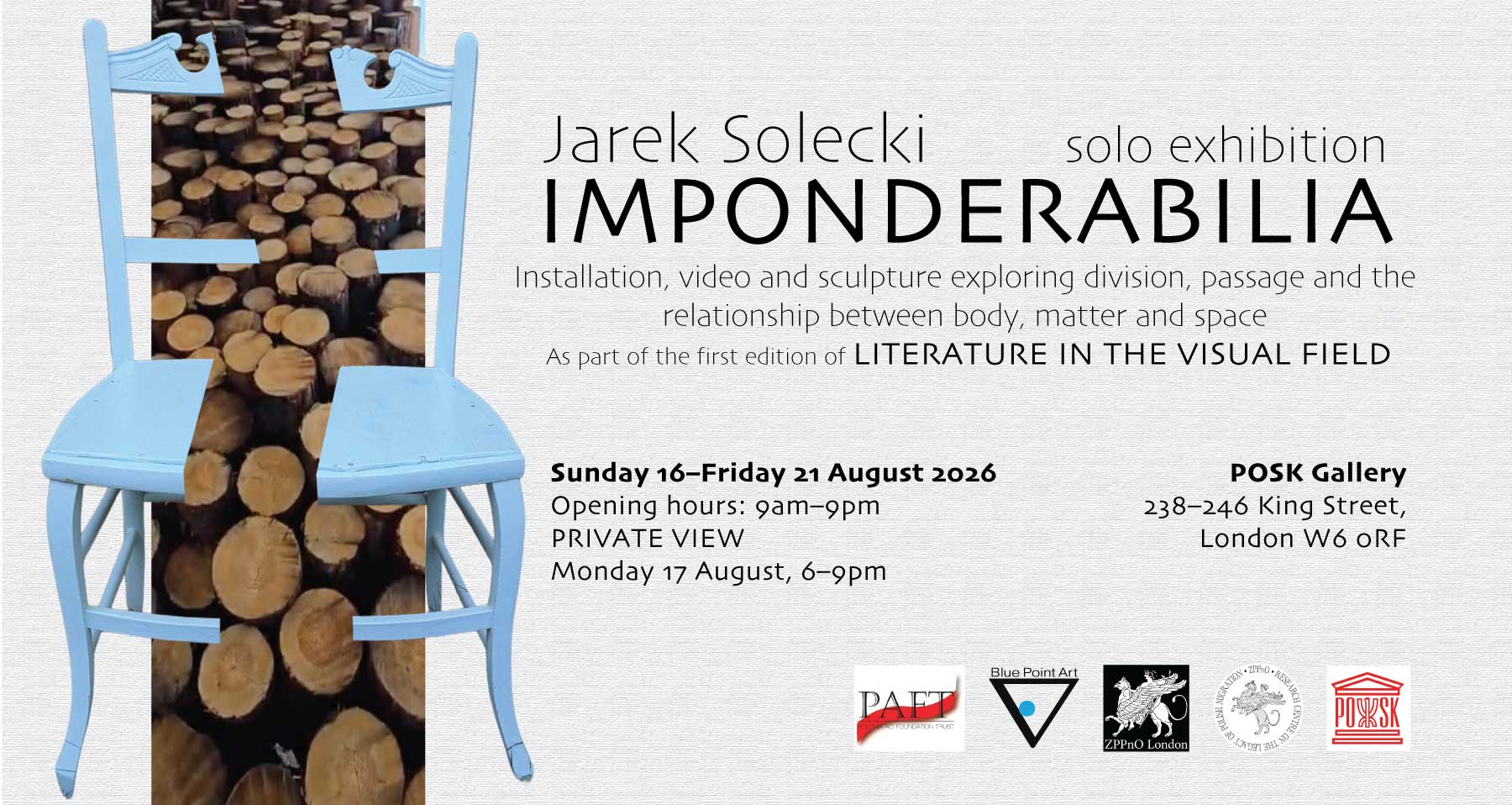
In Imponderabilia, physical materiality once again comes to the foreground in a multi-part installation composed of wood, found objects, readymades and video projection. The exhibition brings together Solecki’s interest in material transformation and spatial relations, positioning the viewer as an active participant whose physical presence and actions become integral to the work.
Jarosław Solecki’s solo exhibition Imponderabilia brings together installation, video and sculpture in an environment shaped by division, passage and the relationship between body, matter and space. Rather than presenting objects to be viewed from a fixed position, the exhibition asks visitors to move through a shared spatial structure. Its meaning unfolds as perspective, distance and the position of the body change.
The exhibition takes its starting point from Marina Abramović and Ulay’s performance Imponderabilia, translating its questions into a different medium and context. Here, the experience of crossing a threshold and negotiating one’s position in relation to the work and to other people is developed through a multi-part sculptural installation and moving image.
Wood is central to the exhibition, not as a neutral material but as an active participant in the artistic process. Its weight, grain, growth rings and accumulated history shape each intervention. Lines, cuts and splits expose the material’s internal structure and create a tension between imposing form and following what is already present within it.
Found objects and reused natural materials extend this enquiry towards the contemporary relationship between people and nature. Without becoming a direct ecological manifesto, the exhibition considers the responsibility carried by an artistic gesture: how matter may be transformed and given new meaning while its own structure is respected.
The physical presence of wood and sculptural objects is set against the mediated character of video. This encounter between organic matter and digital imagery draws attention to the difference between immediate and technologically mediated experience, and to the ways contemporary tools alter our contact with nature, space and our own bodies.
At the centre of Imponderabilia is the fissure—not only as a sign of rupture, loss or absence, but as an opening and a place of transition. A split separates, yet also makes reconnection possible. In the space between divided parts, something previously hidden can become visible.
The exhibition forms the visual centre of the first edition of Literature in the Visual Field. Readings, performances and conversations will take place within the installation, responding to its material and spatial presence while remaining a supporting layer of the wider exhibition experience.
Literature in the Visual Field
The programme was developed through an open call for literary and performative contributions, which is now closed. The call invited writers and performers to enter into dialogue with the installation through text, voice, sound and moving image.
View the full bilingual programme for 16–21 August 2026, including the literary evenings, private view, book presentation and open mic.
The first edition of Literature in the Visual Field is supported by a grant from the Polonia Aid Foundation Trust (PAFT), helping bring together artists, writers and audiences within the exhibition space.
Curator: Justyna Gorzkowicz