Jakob Barua: Polish–Kenyan Poetics of Documentary
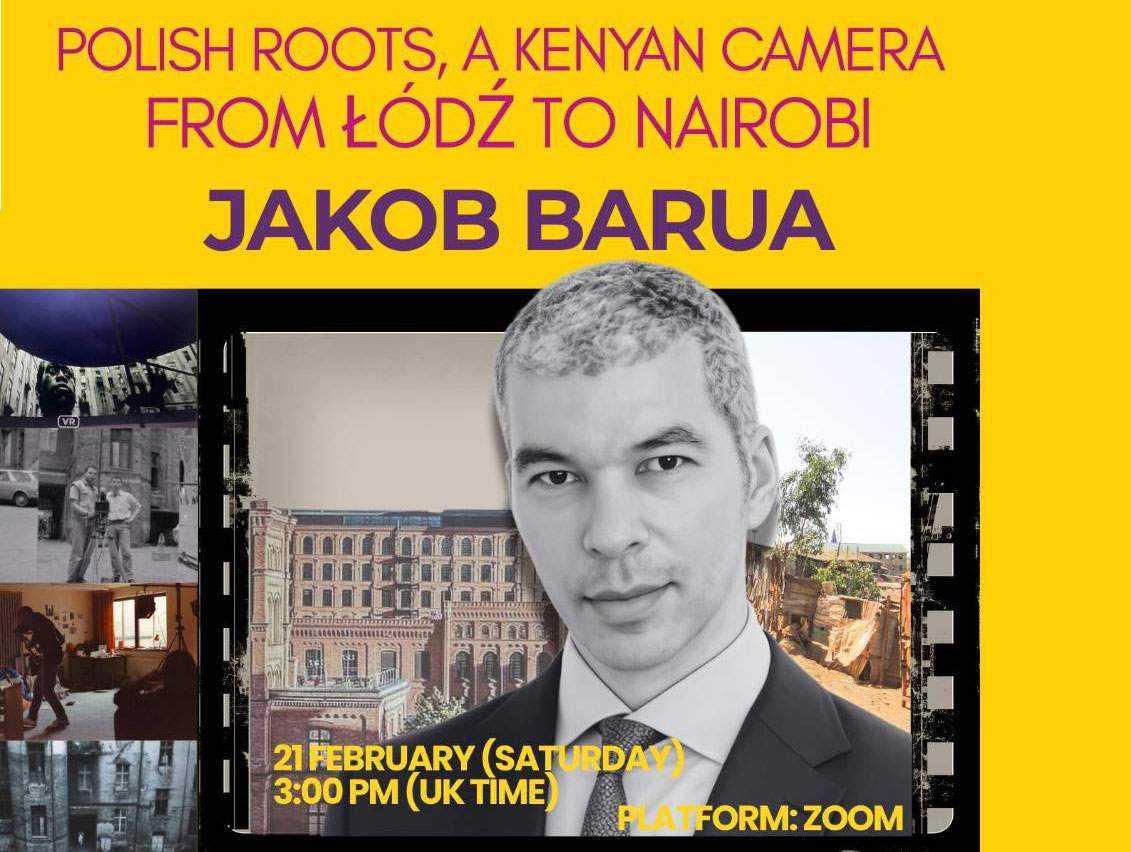
Online talk: Jakob Barua + CAPHE project presentation (Zoom)
You’re warmly invited to an online talk with filmmaker Jakob Barua.
Prof Aleksandra Łukaszewicz will also join us to introduce the project “Hybrid BIO_GEO-GRAPHIES of Jakob Barua” (Virtual Film Memorial).
Hosted by: Dr Justyna Gorzkowicz (OBeDeP) & Dr Teresa Naidoo (PUNO)
Date: Saturday, 21 February 2026
Time: 15:00–17:00 (UK time)
Platform: Zoom
Registration
Please email: [email protected]
(we’ll reply with the Zoom link)
Organisers
- Blue Point Art London
- The Research Center on the Legacy of Polish Migration of the Polish Writers Abroad Charity (London, OBeDeP) — Dr Justyna Gorzkowicz
About the guest: Jakob Barua
Join us for an online conversation with Jakob Barua — a director, screenwriter and film producer, born in Łódź (1967) and based in Nairobi for many years. He is widely recognised as one of the pioneers of modern Kenyan cinema and a leading voice in a personal, “poetic” approach to documentary filmmaking. Barua is also a respected photographer. His work is held in private collections in Denmark, the UK, the USA and Italy, and his photographs regularly appear at international art auctions. Barua’s films often feel like dreamlike journeys through memory. He weaves history and biography together with myth and symbolism, shaping stories that grow out of his multicultural identity. His distinctive, almost painterly visual style can feel surreal — yet it is always rooted in a strong sense of place. An important early chapter of his work was his collaboration with his brother, cinematographer Stan Barua, which helped define the films’ signature look. (Stan moved to Canada in 2000 and has since pursued his own independent career.) Critics frequently highlight Forgotten Places, described as the first poetic documentary in Swahili, as well as Barua’s unique authorial aesthetic across the Poland–Africa axis. Barua studied film and literature at the University of Warwick, and later directing at the Łódź Film School (PWSFTViT). He often says literature is closest to him — and that he chose cinema because it allows different art forms to meet in one medium. His student film This–That (1989) was conceived as a “time capsule”: a contemporary myth, more sensory than journalistic. His later shorts in Łódź were praised for resisting convention — compared to the poetics of T. S. Eliot (The Waste Land) and described by Wojciech Has as “complex riddles”. In 2005–2006, Barua was appointed Director of the Zanzibar International Film Festival (ZIFF) to restructure the festival and raise its international profile. He expanded its focus to include the wider Indian Ocean region, rather than keeping it primarily continental. This became one of ZIFF’s strongest periods — the festival was even nicknamed “the African Venice”, attracting filmmakers from around the world and tens of thousands of viewers. After returning to Kenya, Barua lectured on art and sacred architecture in Nairobi.
Programme
Part 1: Conversation
We’ll talk about the key themes in Barua’s films and how his cinema guides viewers through spaces and memories — from Łódź to the Kenyan coast. We’ll explore how he brings together lived experience (migration, war, life between cultures) with a poetic, symbolic layer of storytelling. Recurring motifs include Icarus (risk and crossing boundaries), ritual (initiation and farewell), and subtle echoes of Conrad (Heart of Darkness). Landscape is also central — the city, the courtyard, the ocean shoreline — shown as a space of memory, legend (including flood myths) and everyday life. We’ll refer to selected films, including: This–That (1989), The Welcoming (1990), In Memory of Me (1990), Forgotten Places (1994), Shades of Poland (1999), My Daddy Was a Cavalryman (2006).
Part 2: Project presentation
Prof Aleksandra Łukaszewicz will introduce the project/exhibition “Hybrid BIO_GEO-GRAPHIES of Jakob Barua” (Virtual Film Memorial), developed within CAPHE project. She will present an immersive format that brings together film, memory and technology (including VR), creating a “virtual archive” and a poetic map of belonging in a Poland–Africa dialogue. The project was presented at a film retrospective at Kenyatta University (4 December 2025) and at the opening of the VR exhibition at the National Museums of Kenya in Nairobi (10 December 2025), with support from the Embassy of the Republic of Poland in Nairobi. The full experience is available online via KONKRET AR.T Gallery (open access). More details are available on the CAPHE website: https://www.caphe.space/caphe-dissemination-update-hybrid-bio_geo-graphies-of-jacob-barua-virtual-film-memorial-in-practice/
We’ll finish with an open Q&A session.
Registration
Please email: [email protected]
(we’ll reply with the Zoom link)
